Something happens when you clear a surface. It is difficult to describe precisely — a small shift in the quality of the room, or perhaps in the quality of your attention to the room. The space begins to breathe differently. And something in you, quite often, begins to breathe differently too.
This is not mysticism. It is a fairly well-documented psychological response to visual complexity. Cluttered environments consistently produce higher reported stress and lower reported feelings of control than organized ones. But the interesting thing is not the stress. The interesting thing is what happens when the stress recedes: a kind of quiet that was there all along, waiting beneath the accumulated objects.
Japan's domestic culture has a long relationship with this kind of quiet. The concept of ma — the active quality of empty space — appears in architecture, in garden design, in the arrangement of rooms. It is not the absence of something. It is a presence in itself. The empty space in a well-designed room is not a failure of filling; it is a deliberate feature. It gives the objects that remain more room to be seen, and gives the mind more room to settle.
Where Clutter Actually Comes From
Most of the clutter in a home is not the result of negligence. It is the result of small, reasonable decisions made over time — decisions that, individually, made sense but which have accumulated into something that no longer does. The book set down on the kitchen table because the bedroom was busy. The bag not fully unpacked because the next trip was soon. The gift not displayed but not yet given away.
These objects carry intention. That is what makes them hard to address. You cannot simply throw away intention. You have to meet it honestly — acknowledge what the object was for, decide whether it still serves that purpose, and if it does not, find a dignified way to release it.
In Japanese homes, the approach to this is characteristically practical. Objects that are used regularly are stored within easy reach, visible, and neatly arranged. Objects used seasonally are stored carefully but out of sight. Objects that are neither are reconsidered. This is not minimalism for its own sake. It is organization as a functional philosophy — a way of ensuring that your home supports your life rather than obstructing it.
"An organized space is not an empty space. It is a space where every object has been chosen, placed, and remembered."
The Bento Box as a Model
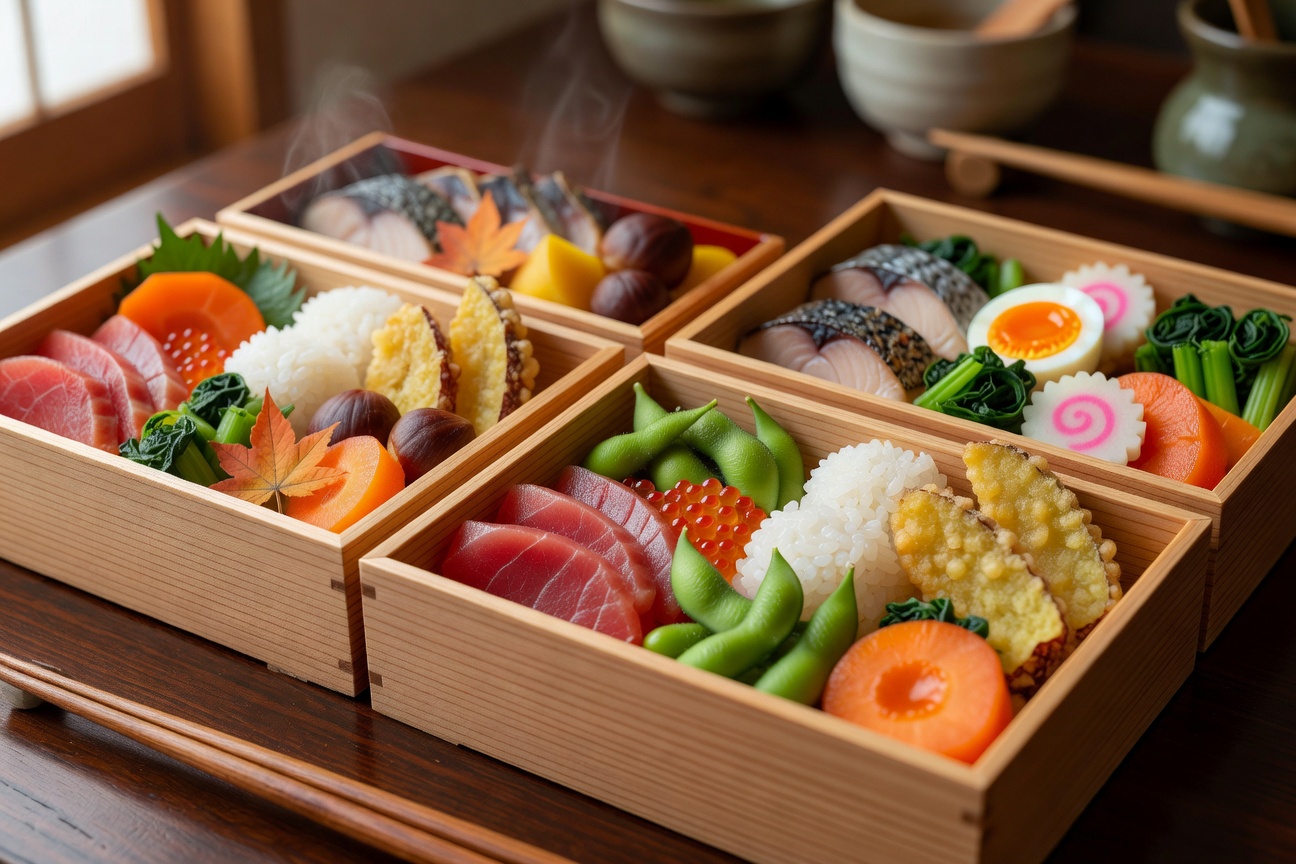
There is something instructive in the Japanese bento box as a metaphor for organized living. A bento is not simply food in a container. It is a carefully considered allocation of space — each section sized for its contents, each element chosen for its relationship to the others. Nothing overflows. Nothing is absent.
The discipline required to prepare a bento well is the same discipline required to organize a home well: an honest reckoning with what fits, what belongs together, and what, however much you might wish to include it, simply does not have a place in this particular arrangement.
This does not mean the home must be sparse or cold. A bento can be elaborate and colourful and deeply satisfying to look at. Organization and warmth are not opposites. A well-organized home, filled with objects chosen with care and arranged with thought, has a quality that no amount of filled surfaces can replicate.
Starting Without Overwhelm
The mistake most people make when they decide to organize their homes is to try to do it all at once. This produces a temporary state of even greater disorder — everything pulled out, sorted, and not yet returned — followed by exhaustion and a sense that the whole project was a mistake.
A more useful approach is to begin with a single drawer. One drawer. Empty it completely. Clean the interior. Then return only what belongs there — only what you actually use and want to keep in this specific location. Do this once. Do not move to the second drawer that same day. Instead, let the completed drawer be what it is: a small island of organization in the broader landscape of the home.
The psychological effect of this small completion is significant. It demonstrates, concretely, that the thing is possible. It creates a reference point — a feeling you can return to when deciding what the next step should be. And it avoids the collapse into overwhelm that comes from attempting to change everything at once.
Over time — over weeks and months of these small completions — the home changes. Not dramatically, not all at once. But it changes in a way that holds, because it is built from repeated, considered choices rather than from a single heroic effort that cannot be sustained.
What Order Actually Gives You
The practical benefits of an organized home are real: things are easier to find, spaces are easier to clean, the visual environment is less demanding. But the deeper benefit is something that is harder to measure and easier to overlook. It is the sense that you are in a relationship with your home — that you know what is in it, that you have chosen what is there, that the space reflects something about how you want to live.
This sense of authorship over your own environment is not a small thing. It is, in fact, one of the quieter forms of self-respect available to us in daily life. To live in a space that you have organized with care is to give yourself a place to be, rather than merely a place to store things in while you wait for the next thing to happen.
This is what Japanese domestic culture has understood for a long time. The home is not a backdrop. It is an active participant in the quality of a life.